.jpg)
Confirm that wildfire is part of the offer
Do not assume that a Nevada homeowners quote includes wildfire because the document is called home insurance. Official legislative materials describe Nevada’s authority to permit wildfire exclusions. That authority does not establish what every insurer currently offers, but it makes a direct question essential: is wildfire covered under this exact policy and its endorsements?
If an offer excludes wildfire, ask whether separate coverage is available, what it would cover, and how the policies would work together. Compare effective dates, deductibles, valuation, smoke damage, and temporary living arrangements. A lender may also need to review the combined arrangement. Never treat a proposal for separate coverage as a policy already in force.
Private-market options and the FAIR Plan question
Nevada does not offer a homeowners FAIR Plan fallback. The state’s official legislative discussion treats a FAIR Plan as a possible policy approach, rather than an operating program. The Nevada Division of Insurance’s consumer FAQ identifies high-risk pools for other types of mandatory insurance; these are not homeowners replacements.
A licensed agent can investigate private-market options, including specialty or surplus-lines coverage where appropriate. Ask which markets were considered, what caused a decline, and whether more accurate property information would change the review. Availability depends on the home and insurer. The insurance options guide helps you compare the possible arrangements without assuming one is always cheaper or broader.
Local guides across Nevada
These examples describe landscape differences, not a ranking of cities or an insurer’s assessment of a particular address. Open a local guide for property-review questions.
| City / area | Why wildfire / brushfire exposure varies | State FAIR Plan? |
|---|---|---|
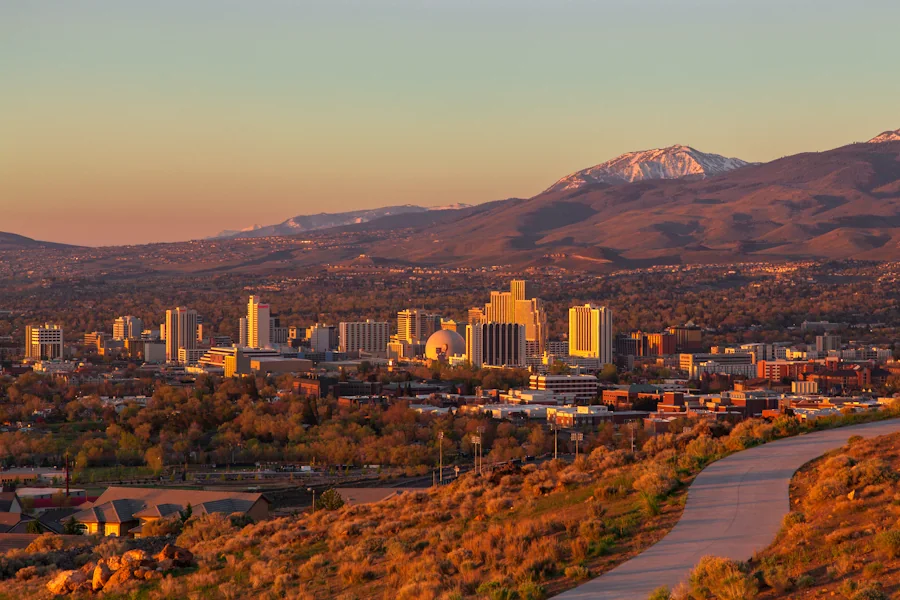
| Reno | Sage-cheatgrass slopes and eastern Sierra foothills. Conditions vary with the lot, nearby fuels, slope, and access. | No homeowners FAIR Plan; compare private options |
| Carson City | Sage basin and steep Sierra foothills. Conditions vary with the lot, nearby fuels, slope, and access. | No homeowners FAIR Plan; compare private options |
| Incline Village and Crystal Bay | Lake Tahoe forest, granite slopes and mountain roads. Conditions vary with the lot, nearby fuels, slope, and access. | No homeowners FAIR Plan; compare private options |
| Gardnerville and Minden | Carson Valley sage, cheatgrass and Pine Nut foothills. Conditions vary with the lot, nearby fuels, slope, and access. | No homeowners FAIR Plan; compare private options |
| Las Vegas Valley Wildland Interface | Mojave shrub, invasive grass and Spring Mountains forest. Conditions vary with the lot, nearby fuels, slope, and access. | No homeowners FAIR Plan; compare private options |
How Nevada property conditions change the conversation
Nevada Forestry’s preparedness guidance brings together community planning, defensible space, vegetation, and construction materials. The state includes forested mountain communities as well as brush and grass settings. A paved neighborhood and a nearby foothill property can require different preparation even when both have the same mailing city.
For a home around Reno, the city’s wildland-urban interface resource offers a starting point for local planning. For a Tahoe-area home, be precise about the state and actual address when asking for insurance help. A program available across a state border should not be assumed to apply to a Nevada property.
Compare the complete insurance arrangement
- Covered causes of loss: obtain the exclusions and endorsements, including wildfire and smoke wording.
- Settlement basis: ask whether the building and belongings are valued at replacement cost or depreciated value, and what conditions apply.
- Living expenses: identify covered reasons for leaving the home, payment limits, and any time restrictions.
- Other protection: check liability, water losses, detached structures, and the intended occupancy.
- Conditions and cost: compare all premiums, taxes, fees, deductibles, inspections, and repair requirements across the arrangement.
If policies are being combined, have the agent explain gaps and overlapping terms in plain language before you make a decision.
Act on a nonrenewal and document improvements
Save the notice and identify the coverage end date immediately. Ask the current insurer whether its decision concerns the location, a correctable condition, claim history, or its broader underwriting approach. Gather declarations, claim details, repair records, and photographs before approaching replacement markets. Ask about reconsideration while also pursuing alternatives; one should not depend on the other succeeding.
Follow Nevada Forestry’s preparedness resources and local fire guidance when planning vegetation and building improvements. Keep a dated record and ask insurers what they will accept as evidence. Mitigation can reduce vulnerabilities, but it does not guarantee a quote or discount. Contact the Division of Insurance for a consumer problem, and confirm the replacement policy’s effective date before allowing an avoidable gap.
Be precise about which Nevada property is being reviewed
A Tahoe-area home, a Reno foothill property, a Carson Valley parcel, and a Las Vegas Valley edge property should not be described with identical wildfire assumptions. The state guide is an introduction to the questions; photographs, construction details, and the actual address belong in the insurance submission.
For a home near a state boundary, confirm the jurisdiction before discussing programs or requirements. For a property near open land, describe where the maintained lot ends and what lies beyond it. Avoid applying a scenic area's reputation to every home sharing a mailing address.
Make the wildfire coverage question explicit
Ask the agent to point to the proposed policy's treatment of wildfire rather than rely on the word homeowners in the title. Read any exclusion, limitation, or endorsement alongside the declarations. If another contract is proposed to address a gap, ask how the pieces work together and which losses could remain outside them.
A side-by-side comparison should include dwelling valuation, contents, additional living expenses, liability, and deductibles. Ask whether inspections or repairs remain outstanding and whether the stated price is subject to additional information. Keep the response with the quotation.
For a seasonal property, plan how notices and maintenance requests will reach you when you are away. If an association manages shared vegetation, retain the relevant maintenance information while documenting the areas you control. Shared work and an individual home's condition are related but are not interchangeable.
Use the Nevada Division of Insurance to clarify consumer issues and state forestry or local fire resources for physical preparedness. Ask each organization questions within its role. A local assessment does not settle an insurance contract question, and a quote does not establish that a property meets every applicable safety requirement.
Revisit the file when the property's use or condition changes. Current photographs and a clear explanation of completed work are more useful than saying a place is safe because a nearby home obtained insurance. Availability and policy terms still require individual review.
Common questions
Does every Nevada homeowners policy cover wildfire?
You must check the exact policy and endorsements. Nevada permits wildfire exclusions, so ask the agent or insurer to identify whether wildfire is included and explain any separate arrangement being proposed.
Can a Nevada home use another state’s FAIR Plan because it is near the border?
Do not assume so. The property’s actual state matters. A Nevada property needs an insurance arrangement available for Nevada; discuss its address and occupancy with a licensed professional.
Will a Nevada community wildfire plan decide my eligibility?
No. Community planning helps organize preparedness. An insurer separately evaluates its application, property information, and underwriting criteria. Ask what documentation it needs for your particular home.
What should I check if wildfire is offered separately?
Check which policy covers the building, belongings, smoke damage, and temporary housing. Compare dates, deductibles, exclusions, and valuation across both policies, and confirm any lender requirements.
Sources and further reading
- Nevada DOI general FAQs
- Nevada legislative committee February 27 2026 minutes
- Nevada Forestry wildfire preparedness
- Reno wildland urban interface preparedness
Program rules and insurance terms can change. Check the linked agency or program before relying on eligibility, coverage, or local requirements.
General educational information. This website does not issue policies, bind coverage, or provide emergency alerts. Coverage and eligibility require individual review.